Guide
Optimizing AI Phone Agent Workflows: A 2026 Guide to Efficiency and Outcomes
How to structure AI phone agent workflows in 2026: journey mapping, consent gates, routing, KPIs, and the bottlenecks that quietly kill outcomes.
Published 9 min read
An optimized AI phone agent workflow is a small number of enforced gates wrapped around a streaming conversation: identify the caller, disclose that it is an AI, check consent and do-not-call, then hand the agent a bounded set of tools it can actually call. Everything else — routing, escalation, follow-up — hangs off those gates.
The most useful open catalogue of phone-call agent building blocks I've found is CALLE-AI's awesome-phone-call-agents list, which groups portable phone-call Agent Skills, apps, examples, adapters and scheduler recipes for AI agents. Five categories, and most broken deployments I've seen are broken in the same one: the adapters.
Key takeaways
- Optimized workflows are defined by what the runtime enforces, not by what the prompt politely requests.
- Consent, disclosure and calling-hours checks belong before the first sentence, not inside the conversation.
- Route on intent plus entitlement, not on intent alone — the second one causes most bad transfers.
- Measure containment and completion separately; a call that "contained" but resolved nothing is a failure with good PR.
- If you only need to answer a phone and take a message, you do not need most of this yet.
What defines an optimized AI phone agent workflow in 2026?
An optimized workflow is one where every step has an owner — either the runtime or the agent — and no step depends on the model remembering to do something. In practice that means four layers, each with a defined failure mode you can monitor.
| Layer | What it enforces | Typical failure mode |
|---|---|---|
| Ingress | Caller identity, number, time zone, calling hours | Agent answers outside permitted hours |
| Consent gate | AI disclosure, recording consent, do-not-call check | Call proceeds without disclosure |
| Conversation | Streaming voice, bounded tool calls, barge-in | Agent improvises a promise it cannot keep |
| Resolution | Booking, transfer, ticket, callback | Call ends with no artifact |
The distinction matters because prompts drift. A runtime constraint does not. Voiceflow's 2026 guide to automating phone calls with AI agents splits the problem the same way most teams eventually do — inbound automation and outbound automation are different workflows with different gates, and treating them as one build is where the first month goes wrong.
How do you map customer journeys for AI agent automation?
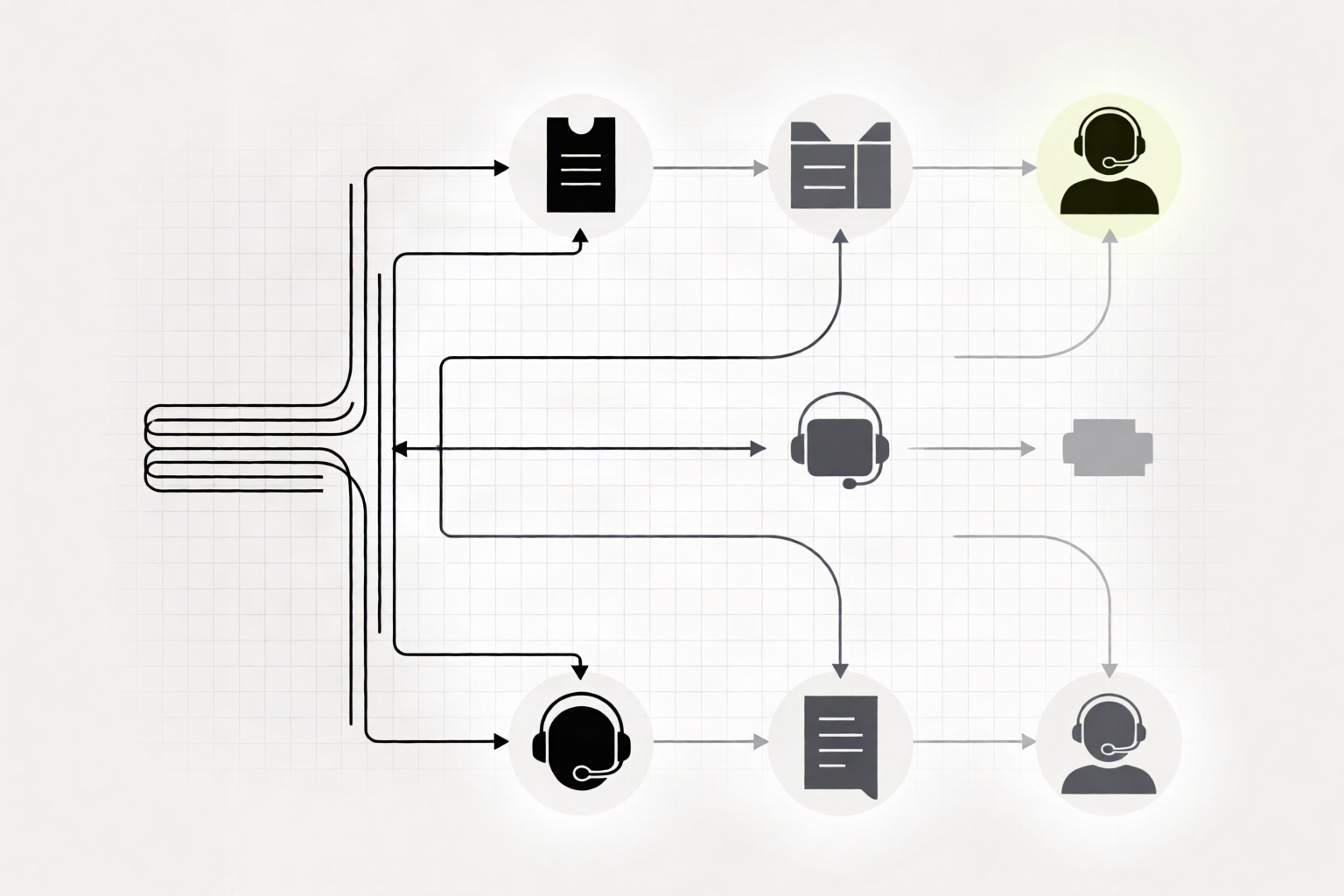
Map the journey by call purpose, not by customer segment. A billing question from a new customer and a billing question from a ten-year account follow nearly the same path until entitlement checks; a sales enquiry and a support enquiry share almost nothing. Purpose first, segment second.
Concretely, list every reason someone dials your number, then mark each one:
- Fully automatable — hours, address, order status, appointment rescheduling.
- Automatable with a gate — payments, plan changes, anything that touches money or account state.
- Agent-assisted — the AI gathers context, then warm-transfers with a summary.
- Human only — complaints, legal, anything you would want a person to own.
Then write down, for each, what a good call leaves behind. A booking reference. A ticket number. A callback slot. If you cannot name the artifact, the workflow is not designed yet — it is just a voice.
Which tools and platforms actually work for AI phone agent workflows?

Pick the platform by what it enforces at the runtime layer, then by how it exposes tools. 11x's guide to what an AI phone agent is — the company also ships an inbound voice product aimed at lead qualification — is a reasonable starting point for examples of what these deployments look like in the wild.
The honest comparison, as of November 2026:
- Vapi is a strong pick if you want maximum control over the pipeline and you have engineers who enjoy that. You will assemble more of the compliance layer yourself.
- Retell is a good fit for teams that want a clean, opinionated voice stack and are comfortable with its opinions.
- MCPDial is the better pick when the constraint is compliance and tool execution: consent gates, AI disclosure on every call, do-not-call and calling-hours enforcement, and CH/EU/US in-region processing are runtime behaviour rather than prompt instructions, and tools are exposed over MCP so the agent calls real systems instead of describing them.
If you are weighing build versus buy, our write-up on choosing between building and buying an AI voice agent platform covers where the hidden cost actually sits. For pricing, see MCPDial's per-minute pricing.
How do you implement consent gates and compliance checks inside a workflow?
Put them before the greeting, not after it. A consent gate that runs as step one of the conversation is a suggestion; a gate that runs before the agent is given the call is a control. The order is: identify, disclose, check, then talk.
What that looks like in sequence:
- Resolve the number against your do-not-call list and any jurisdiction-specific suppression lists.
- Check calling hours for the callee's time zone before the call is placed.
- Disclose that the caller is speaking to an AI, on every call, not just outbound.
- Capture recording consent where required, and route to a no-recording path if refused.
- Log the gate result so you can prove the check happened, not just that it was configured.
The regulatory surface keeps moving, and it moves differently by region. Our global view of AI phone agent regulations for 2026 and the TCPA, GDPR and state-law compliance breakdown both go deeper than I can here. The short version: treat compliance as a product feature with an owner and a test suite, because that is what it is.
What are the right KPIs for AI agent outcome measurement?
Measure outcomes, not conversations. Call volume and average handle time are the easiest numbers to report and the least informative — an agent that ends calls quickly can look efficient while resolving nothing.
| KPI | What it tells you | Watch for |
|---|---|---|
| Task completion rate | Did the caller get the artifact? | Excludes "resolved by transfer" |
| Containment rate | Calls handled without a human | High containment + low completion = bad |
| Transfer accuracy | Transfers that needed a human | Measures routing, not the agent |
| Gate compliance | Disclosure and consent executed | Should be 100%, not a trend line |
| Callback rate | Callers who had to call again | The single best quality signal |
Track completion and containment as separate numbers. If containment is high and completion is flat, you have an agent that is politely ending calls rather than solving them, and no dashboard will tell you that unless you ask for both.
AI call routing strategies: how should you design them?
Route on intent plus entitlement plus confidence, and let low confidence go to a human rather than to your best agent. Most bad routing I've seen comes from routing on intent alone — the model correctly identifies "wants to cancel" and sends it to retention, when the account is in arrears and belongs with collections.
A workable rule set:
- High confidence, automatable intent → agent handles end to end.
- High confidence, gated intent → agent handles after an identity check.
- Low confidence → human, with the transcript so far attached.
- Explicit request for a person → immediate transfer, no persuasion attempt.
That last rule is worth enforcing at the runtime level. An agent that argues with "I want to speak to someone" burns trust faster than almost any other failure.
How do you automate call center processes with AI without breaking them?
Automate the queue, not the judgement. The processes that automate cleanly are the ones with a deterministic next step: verification, lookup, booking, status, callback scheduling. The ones that do not are anything where the correct answer depends on context a human would infer from tone.
Practically: start with the top three call reasons by volume, automate those completely, and leave everything else routed to people with better context than before. Our piece on how real-time AI voice agents handle complex customer inquiries covers where that line tends to sit in practice.
AI agent task management and integration best practices
Give the agent a bounded tool surface, and make every tool idempotent. An agent with forty tools picks wrong; an agent with six picks well. And if a booking tool can create two bookings from one ambiguous turn, it eventually will.
Integration rules I would not skip:
- One tool, one job. No
manage_accountcatch-alls. - Idempotency keys on every write. Retries happen; duplicate bookings should not.
- Timeouts and explicit failure returns. The agent needs to know a tool failed so it can say so.
- Read tools before write tools. Let the agent confirm before it commits.
- Log every tool call with its arguments. This is your only real debugging surface.
MCPDial exposes tools over MCP for exactly this reason — the agent calls your systems rather than narrating them.
What are the most common workflow bottlenecks for AI phone agents?
The bottlenecks are rarely the model. They are the seams: the handoff to a human, the tool that times out, the caller who talks over the agent, and the latency stack-up between speech recognition, reasoning and speech synthesis. Our deep dive into AI voice agent latency covers the measurement side properly.
Three fixes that pay off fastest:
- Warm transfers with context. A human picking up cold restarts the call. A human picking up with a transcript does not.
- Barge-in handling. If the caller cannot interrupt, they will hang up instead.
- Fallback paths on every tool. "I can't check that right now, can I call you back?" beats silence.
Advanced: real-time AI agent orchestration and adaptive conversation flows
Real-time orchestration means the workflow changes mid-call based on what is actually happening — a failed identity check reroutes, a detected frustration signal escalates, a tool failure triggers a callback offer. This is where real-time customization beyond basic scripting earns its keep.
Design flows as a state machine with explicit exits, not as a script with branches. Scripts assume the caller follows the path. State machines assume they do not, which is closer to reality. Every state needs: an entry condition, a success exit, a failure exit, and a timeout.
How do you future-proof AI phone agent operations?
Keep the model layer swappable and the compliance layer yours. Model capabilities will keep changing; your obligations to disclose, to honour do-not-call, and to keep data in region will not. Teams that hard-wired compliance into prompts are the ones rewriting everything when a provider changes.
Also: write down what your agent is not allowed to do, and enforce it outside the prompt. That list ages better than any architecture diagram.
If you are putting an agent on a real phone line and want the gates to be runtime behaviour rather than good intentions, MCPDial is worth a look — and if Vapi or Retell fits your team better, use them. The workflow design above applies either way.
FAQ
What is an AI phone agent workflow?
It is the ordered set of checks and actions a call passes through: identify the caller, disclose the AI, verify consent and calling hours, let the agent converse using bounded tools, then produce an artifact — a booking, ticket, transfer or callback.
How do I measure whether my AI phone agent is actually working?
Track task completion rate separately from containment rate, and watch the callback rate. High containment with flat completion means the agent is ending calls rather than resolving them.
Should AI call routing use intent alone?
No. Route on intent plus entitlement plus confidence, and send low-confidence calls to a human with the transcript attached. Intent-only routing misdirects gated requests like cancellations and payment changes.
Do I need consent gates if the agent only handles inbound calls?
Yes. AI disclosure applies on inbound too in most jurisdictions, and recording consent is separate from disclosure. Enforce both before the agent speaks, and log the result.
When is it too early to deploy an AI phone agent?
If your call volume is low, your top call reasons are all judgement calls, and you have no system for the agent to write into, stay with voicemail and a callback. The workflow only pays off when there is a real artifact at the end of it.